3/9/2026MCWC Team4 min readConsulting
Efflorescence on Terraces and Balconies: Why It Shows Up at Closeout—and Why It Sometimes Reaches Glass
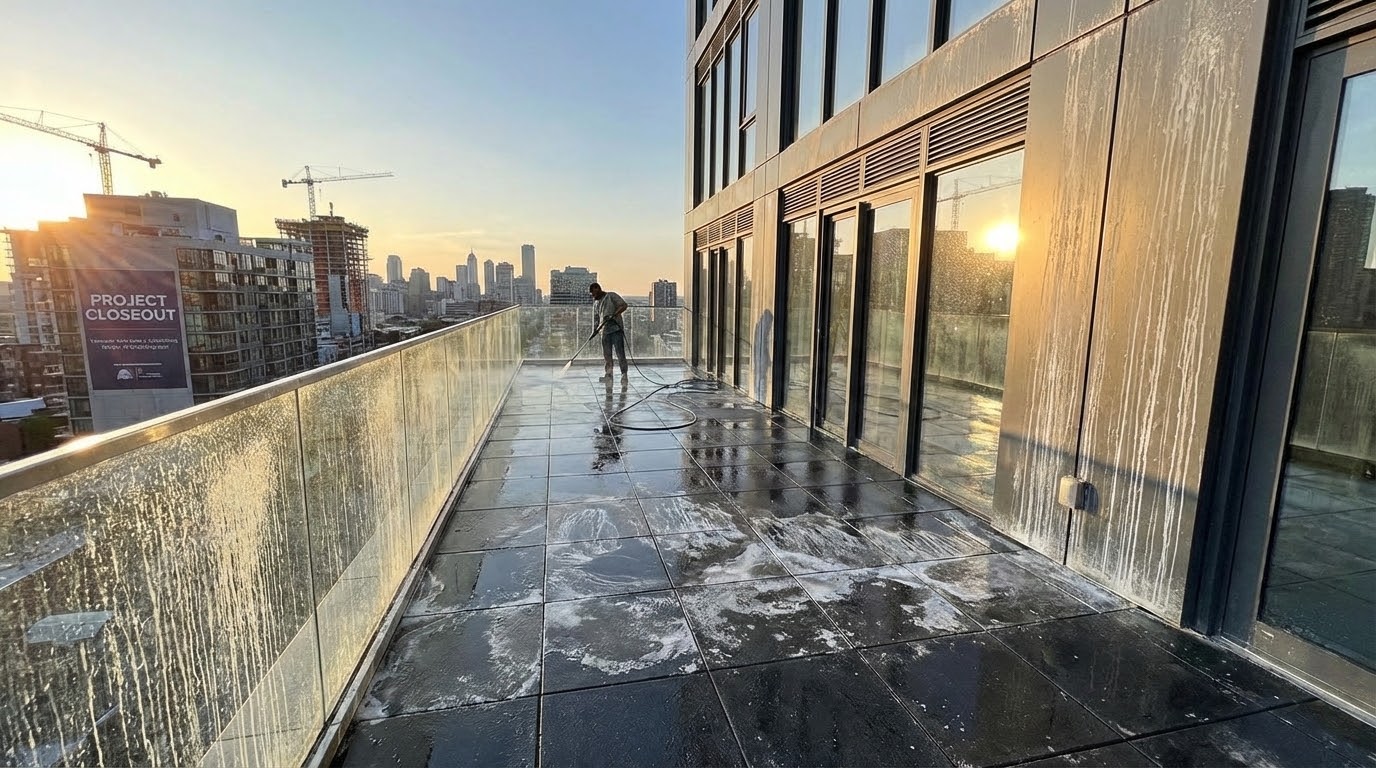
White residue on exterior tile or pavers is often treated as a cleaning issue. On active projects, it tends to become something else: a coordination issue that can slow closeout, create trade disagreement, and trigger uncertainty about “who owns it”—especially when runoff reaches glass, metal, or adjacent facade finishes.
From MCWC’s perspective as waterproofing specialists and building envelope inspectors, the value isn’t in labeling the residue from a photo. The value is in recognizing what the symptom often signals: repeatable moisture movement through a terrace assembly—and the project risks that come with it.
Why decision-makers should care
When efflorescence persists or returns after cleaning, it commonly creates:
- Competing opinions between trades (“tile problem” vs. “waterproofing problem” vs. “maintenance problem”)
- Rework pressure late in the schedule (when access is hardest and finishes are already installed)
- Owner perception issues (high-visibility terraces read as “quality problems”)
- Warranty and responsibility debates, especially at thresholds and edges
Efflorescence doesn’t automatically mean the waterproofing failed. But it often means the project should align on how water is entering, moving, and exiting the assembly before the conversation turns into a stalemate.
The most practical way to think about efflorescence
In plain terms, efflorescence is residue that appears when moisture moves through cement-based components (mortar, grout, setting materials) and leaves calcium carbonate deposits behind as it dries. What matters most in the field is not the definition—it’s the pattern and frequency:
- Does it show up in the same locations repeatedly?
- Is it concentrated near perimeters, curbs, or low points?
- Does it appear near discharge points where water exits the terrace?
- Is it isolated to the walking surface—or migrating to adjacent materials?
Patterns tell you whether you’re dealing with a one-time cleanup item or a repeating moisture pathway that deserves a closer look. The amount and frequency of the efflorescence should be minimal. It can be expected that at first some of the debonded material may arise at first. Usually, the material can be pressure washed and crisis averted. However, it is a crisis when the blemishes and stains reappear. Usually, the cause for frequent occurrence is associated to the mortar cement selected.
Why terraces and podium decks are common problem zones
Terraces, balconies, and podium decks experience constant wetting and drying—rain, wind-driven exposure, washing, and sun-driven evaporation. And importantly: tile and pavers are not automatically “watertight.” Water can penetrate at joints, transitions, permeable materials and semi permeable materials.
When an assembly manages water well, that moisture movement stays controlled. When it doesn’t, the symptom often shows up as recurring residue—and the owner inherits a problem by the end of the project.
Where these issues tend to escalate: transitions and “handoff zones”
The recurring theme is that many problems, often wrongfully blamed on waterproofing, actually are provoked by the design professional by not providing a balanced storm management plan.
Efflorescence conversations often accelerate when they intersect with:
- Door thresholds and finish elevations (where drainage expectations are sensitive)
- Perimeter edges and curbs (where water exits and can track down adjacent surfaces)
- Finish build-up changes (where water can linger longer than intended)
- High-rise exposure zones (where conditions repeat and visibility is high)
These aren’t accusations. They’re the locations where alignment on detailing intent and installation sequencing matters most—because that’s where symptoms become disputes.
Why adjacent glass changes the stakes
Efflorescence becomes a higher-consequence issue when water carries residue beyond the tile surface. Once runoff reaches glass, metal, or painted finishes, the project may face repeated cleaning cycles and more scrutiny from ownership—while trades debate the source.
This situation highlights another key reality: well-intended “quick fix” cleaning advice can create additional risk if the wrong method is used on sensitive surfaces. Information should stay simple: cleaning approaches should be coordinated with manufacturer guidance and qualified professionals, not improvised late in the schedule. When in doubt only use water and soap on a regular basis on the surfaces of the building exterior.
How MCWC helps teams get ahead of this
MCWC is brought in when teams want clarity—not assumptions.
Our role is to evaluate an assembly in building-envelope context and support informed decisions, typically through:
- Review the “basis of design” and compliance with the owner performance requirements tied to terrace waterproofing, glazing, railings, cladding and roofing.
- Field observation at key interfaces (thresholds, perimeters, discharge points)
- Clear documentation that helps teams align on likely moisture pathways without defaulting to a single-trade blame narrative
This is especially valuable on tile over waterproofing and pavers over waterproofing conditions, where the performance question usually lives at the interfaces between scopes—not in one product alone.
The bottom line for PMs, developers, and A/E teams
Efflorescence doesn’t automatically mean a terrace has “failed.” However, a high frequency of occurrence of efflorescence most often results from improper selection of the mortar cement, or installation, or some combination of both.
If your team is seeing recurring residue on an exterior terrace—particularly where runoff reaches glass—MCWC can help evaluate the assembly context and document the likely pathways so your team can align on next steps early, while options are still practical.